
Delmore Schwartz, The Ego Is Always at the Wheel
I don't think this would get published anywhere today without extensive edits for clarity or vindication for prolixity.
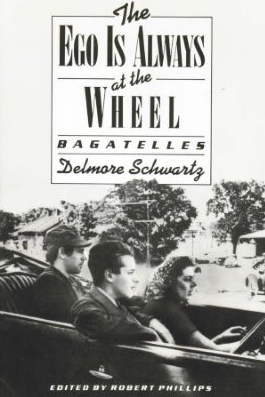
The Ego Is Always At The Wheel by Delmore Schwartz is a book I first happened upon around 2009 as an unreformed teen angst Joycean through some mundane, long forgotten pre-AI Googling.
I then actually acquired and read it thanks to the miraculous time capsule of bookmarks I uncovered in late 2022 from over a decade prior, securing the last available copy I could source through Bookfinder.com at the time and promptly reading it, making no notes about it, and steeping in his uncanny brand of humble, observational humour that is only staccato at times when self-interrupted with ironic bloviations that he really wrote the devil out of for personal affect, I gather.
For The Ego Is Always At The Wheel are not only essays about a poet with a driver’s license (and more impressively, a taste for cars) from the 1940’s and ’50s, one short of half of them remained unpublished by the time of his demise in 1966 and were only published 20 years later by his literary executor Robert Philipps through New Directions, in the company of 10 others previously appearing in print.
The fact that I had encountered this tome as merely a bibliographic record, bookmarked it and forgot about it (before becoming a book reviewer 2 years later, in 2011!) only to unexpectedly encounter it again more than a decade later and finding the only copy I could through an aggregate search engine for secondhand books made me feel like a lordly time traveller with an ethernet cable who knew how to use it.
I remember the days passing quickly between ordering it and receiving it, giddy with untold excitement for whatever awaited my inner child inside it.
Amusingly, the title reads Bagatelles underneath, and Phillips, it appears, chose an optimal epigraph by Jonathan Swift to introduce the collection: Vive la bagatelle, borrowing it from Schwartz’s collection wherein a half dozen of these pieces were previously published, including the namesake of this collection, Vaudeville for a Princess, which Phillips describes in his foreword as Schwartz’s
“most playful book of poetry and prose.”
I wish I had taken that name for this blog, truthfully, it is just as fitting perhaps, although I unfortunately cannot claim to possess the verve and vivacity of Swift as a critic, and feel more at home with the Goncourt-inspired plural noun I ended up with… alas!
It may be as rare to envision a 20th-century poet as an avid motorist as it is to imagine them as an active humorist, but that is exactly what these essays (I prefer to call them essays regardless of length) represent.
As early as March 1, 2025, I had added it to a list of books I could potentially review for Bibelotages on the simple merit that it already stood in my personal library somewhere, previously enjoyed, among others.
I don’t want to say I forgot about it again, for his essays have lived rent-free in my mind since the tail-end of 2022, especially “Hamlet, or There Is Something Wrong with Everyone”, which first appeared in Vaudeville in 1950, but really felt like a premise that my former blog’s co-founder Davin Allan and I had at some point in time post-2011, which was meant to be a Twainian counterpart to our literary criticism blog Literatured called Literatrite, where we would write bad faith criticism, tongue-in-cheek, to elevate our beloved classics in a farcical way; we ended up scrapping the idea and eventually, Davin’s blogs about Shakespeare for Literatured became more popular than the rest of the blog itself, drawing some fraction of a million viewers over the several years they remained online.
But his other essays bore more universal merit, I think, less specific to me and abandoned creative endeavours of youth, which I’ll get to after thanking the person who inspired me to finally review this long neglected paperback collection of bagatelles, and that person is none other than Stuart Ross.
Earlier this year, I enrolled in Stuart Ross’s Introduction to Poetry at University of Toronto’s School of Continuing Studies, having recently left my job and feeling in need of some routine to help me restructure my free time. It was so much more fulfilling than I had bargained for, not only providing ample assigned reading lists which I had no idea I missed from my salad days in undergrad, but instilling an enthusiasm for forms and experimentation in poetic writing I had only hoped would help me better review books but has resulted in me editing decades-old material and producing new poems after a long hiatus of feeling uninspired, in a resilient way I never expected to overcome.
During one of our final sessions, Stuart Ross shared a poem of his own that was recently published about Delmore Schwartz, which he titled after the American himself:
Delmore Schwartz
Stuart Ross
Ever heard of Delmore Schwartz?
I used to read him but I’ve
never actually typed his name before.
Has anyone else in life
ever been named Delmore?
Sometimes I confuse him
with Weldon Kees. One of them
had a recurring character in their poems
named Robinson. Or was that
Robert Lowell? I mean, John
Berryman. No, John Berryman
had a character named Mr. Bones.
Maybe. Delmore’s car
was found on a bridge
on the day I was born
in 1959. Or else I just invented
that. Facts are funny things.
You can look them up or
make them up. For instance,
it was Weldon Kees whose car
was found on some famous
bridge in San Francisco on
my birthday, but four years
earlier than I was born. Did
the world exist before I was born?
Or am I just a character
in your imagination, you whose
birthday marks the beginning
of the world? Happy birthday,
dear reader.
I couldn’t help but recommend The Ego Is Always At The Wheel, only to suddenly bristle up against my own stream of consciousness not knowing exactly why I felt compelled to blurt it out. Surely it stayed with me, but how? I last read it more than 3 years ago now.
I have now re-read it for this review to once again take in that feeling of finally reading the prose of an author whose only work I had consumed beforehand had been his poetry, when his whole appeal to me originally had simply been his biography, specifically an anecdote of him at the White Horse Tavern with an absolutely graffitied copy of Finnegans Wake that he’d always bring along with him, reportedly, covered in marginalia page after bleeding page. I used to have a copy of Literary Anecdotes or some such, published by Penguin or Puffin, that must’ve been where I first heard of the great Joycean, Delmore Schwartz.
The opening few words are a welcome hug back after all these years:
I myself never cared very much for cars, but as the years pass I can see how serious and significant a part they have played in my life. In 1929 when my family was rich, or supposed to be rich, I was given the gift of a Chrysler Royal coupe, brand-new. I did not know how to drive and our chauffeur had to teach me and the first thing I did at the wheel, turning the corner, was to drive into a truck, but slowly, so nothing bad happened. I have hardly had any accidents since then, for this beginning made me very cautious. I wanted to give up driving right then and there, but the wise chauffeur insisted that I continue, or otherwise I would never be able to drive a car.
…
After two years, during which time I suffered at the hands of the fair sex and also suffered because I expected girls to fall for my car, and suffered also because I was driving without a license and scared by every cop who glanced at me, I had to sell my car to pay my tuition fees at the university where I was supposed to be studying. I was cheated in the deal, but that’s another story. The main point is that the depression had begun and that my family was not rich, as had been supposed, and I did not have the money to pay for the upkeep of the car.
…
So there I was on the road again. Allons! I said to myself, as Walter Whitman used to say, once more without a driver’s license just like in 1929 when I was too young to be permitted to get one in the State of New York which is pretty strict. And my emotions were pretty much the same—le plus ça change, le plus c’est la même chose—fear of the cops, bravado based on the probability and improbability of being halted, nervousness which doubtless went back to the strain of being hauled with great difficulty into this brave new world (it was a spectacular labor, I am told, and it was not until my mother accidentally kicked her father’s photograph off the bedroom wall that the doctor said to my dubious and anxious father that everyone was going to be all right, a superficial remark if I ever heard one). Nevertheless, I drove with ever-increasing composure, and even, one might go so far as to say, a certain serenity, poise, and power, going north and feeling very good, despite the illegal character of my activity. For it had occurred to me to think of my first three cars, and when I compared them with this new car, I was very pleased. First the 1929 Royal coupe in 1929, next the 1929 Ford in 1930, third the 1928 Chevrolet in 1939-40, but now, after so many years of poverty and various kinds of oppression, chiefly internal, I owned a 1936 Buick in 1949.
I remember reading this then, in 2022, writing my own poem about the novelty of a poet who can drive:
Stick Shift Sonnet
Jay Miller
Every poet knows the highway:
the traffic ages but road’s the same;
from the moment you leave the driveway,
the radio rumbling to the rhythm of motorcade.
Fleeting thoughts of you, rain or shine.
Vistas in parallax from the bridge made of income tax.
The distance shimmering as I ride,
switching lanes, passing by Cadillacs and Pontiacs.
Billboards pass synced with commercial breaks:
fractal zoom still life marquee hitchhikers
fenceposts lightning strikes skyscrapers earthquakes
tickertape countryside motorcycle rally bikers.
Outlaws and in-laws, thoroughfare and are we there yet?
Almost, almost—just a li’l further, ’til I know where—yeah.
Who do I think I am, Gary Barwin? Sharing my own poetry on my own newsletter... I don’t even drive stick! We can’t all be the speaker of every poem we write.
Re-reading for this review, I kept a running mental checklist of the unpublished essays because I figured those are the ones people are gonna care about:
- On the Telephone
- Dostoevsky and the Bell Telephone Company
- The Famous Elephant
- Publicity (Survey of Our National Phenomena)
- The Farmer Takes His Time
- An Author’s Brother-in-Law
- The Naming of a Hotel
- Streetcar, the Metaphor
- Memoirs of a Metropolitan Child, Memoirs of a Giant Fan
Which is a phenomenal start.
His executor mentions somewhere in the preface that Schwartz had handwritten drafts, typeset variants, and notes, but no table of contents, unlike the posthumous poems he had prepared.
I reread “On the Telephone” and “Dostoevsky and the Bell Telephone Company” over breakfast about a week ago and died laughing at a certain passage.
The “On the Telephone” essay is endearing but not incredibly prescient or memorable by any standards; Schwartz bemoans Alexander Graham Bell’s distraction and “agrees” with a friend of his who reportedly said “What a pity that Henrik Ibsen did not know about the telephone.” He agrees by following up with: “If you want to find out just how much wisdom there is in that observation, get away from your phone, get a room in a hotel, tell them not to put through any calls, and start rereading Ibsen’s plays, if you can stand them.”
The essay after it, however, far more affable and odd. Back before Bell Labs had produced the C programming language, cellular wireless, or fibre optics, they appeared to be suffering a drought of cultural capital.
Delmore Schwartz writes:
“For to be the president of a Bell company had been, for generations, a mark of genuine eminence, superior status, and unquestionable knowledge. Obviously such eminence was much reduced, and perhaps annihilated, when it became clear to others that the man on top was an ignoramus in matters of high culture, a human being who was not only ignorant, but misinformed and confused in matters of high culture and men of the greatest creative genius. The possibility of error and delusion was fearful and boundless.”
What a time to be alive.
He continues, with deadpan whimsy: “It was all to easy to suppose that Leopardi was the name of an excellent Italian typewriter, that Renoir was the name of an expensive French sports car, that Olivetti was a great lyrical poet, that William Saroyan wrote The Divine Comedy—to say almost nothing again about identifying Hegel and the bagel, the zeitgeist and zwieback, Charlotte Brontë and charlotte russe, chop suey and Tschaikovsky and Kung-Fu-Tse, Charles Lamb and lamb chop.”
Writers, in general, were expected to know more back then, even as recently as the nineties. A list of what Vogue applicants were orally examined on in 1994 went viral last summer after appearing in Michael M. Grynbaum’s Empire of the Elite: Inside Condé Nast, the Media Dynasty that Reshaped America:
Devised by the Vogue editors William Norwich and Charles Gandee, the list is an insight into the status-conscious universe that Condé wanted employees to be conversant in, even those whose main role at the company would be fetching cappuccinos for their boss. Want to be a part of Condé Nast? This was your obstacle course:
Condé Nast’s take on a prerequisite cultural Who’s Who
Pedro Almodóvar
American Psycho
Marian Anderson
April is the cruellest month
Richard Avedon
Azzedine Alaïa
Robert Altman
BAM
Barbarians at the Gate
St. Barts
Anne Bass
Cecil Beaton
Sandra Bernhard
Bernardo Bertolucci
Manolo Blahnik
Molly Bloom
Mary Boone
Breathless
Tina Brown
Holly Brubach
CAA
Jane Campion
John Cassavetes
Chateau Marmont
Tina Chow
Claridge’s
Eldridge Cleaver
Francesco Clements
The Conformist
The Connaught
Quentin Crisp
Mrs. Dalloway
Evan Dando
Angela Davis
Day of the Locust
Norma Desmond
Leonardo DiCaprio
Barry Diller
DKNY
Dolce & Gabbana
Isadora Duncan (How did she die?)
Marguerite Duras
Marian Wright Edelman
8 1/2
Michael Eisner
Bret Easton Ellis
Esalen
Even Cowgirls Get the Blues
The Face
Jerry Falwell
Fassbinder
Fear of Flying
Henry Fielding
Karen Finley
Eric Fischl
Gennifer Flowers
For a long time I used to go to bed early
Eileen Ford
“44”
Jean Michel Frank
Stephen Frears
Freud: Bella, Lucian, Sigmund
Squeaky Fromme
Larry Gagosian
Jean Paul Gaultier
David Geffen
Frank Gehry
André Gide
Romeo Gigli
Ruth Ginsburg
Jean-Luc Godard
The Good Soldier
C. Z. Guest
Jessica Hahn
Ashley Hamilton
Eve Harrington
Jean Harris
Juliana Hatfield
Haute Couture
Hermès
Jenny Holzer
Humbert Humbert
Iman
Derek Jarman
Jim Jarmusch
Tom Jones
Neil Jordan
Jules and Jim
Louis Kahn
Rei Kawakubo
Ken Kesey
Jack Kevorkian
Anthony Kiedis
Anselm Kiefer
Jamaica Kincaid
Larry Kramer
La Dolce Vita
Christian Lacroix
Karl Lagerfeld
Le Corbusier
Annie Leibovitz
Fran Lebowitz
Courtney Love
David Lynch
The Magic Mountain
Janet Malcolm
Robert Mapplethorpe
Peter Martins
Hattie McDaniel
Jay McInerney
Steven Meisel
Susan Minot
MOCA/MoMA/La Mama
Kate Moss
Vladimir Nabokov
Liam Neeson
S. I. Newhouse
Frank O’Hara
Oribe
Our Lady of the Flowers
Out
Michael Ovitz
Palais-Royal
Bob Packwood
Paris, Texas
Irving Penn
Père Lachaise
PETA
Pink Flamingos
Place des Vosges
Sylvia Plath
Ezra Pound
Prada
Prescriptives
Wolfgang Puck
The Raleigh
Charlotte Rampling
Herb Ritts
Gena Rowlands
Dominique Sanda
Ed Schlossberg
Jean Seberg
The Seventh Seal
Donna Shalala
Cindy Sherman
Randy Shilts
Andrew Shue
Siegfried & Roy
Mona Simpson
Anna Deavere Smith
Anna Nicole Smith
Paul Smith
South Beach
Spago
Special K
Gayfryd Steinberg
Jon Stewart
Ben Stiller
Stonewall
Studio 54
Niki Taylor
Trash, Heat, Flesh
James Truman
Christy Turlington
Cy Twombly
Gus Van Sant
Eddie Vedder
Veruschka
Diana Vreeland
George Wallace
Wendy Wasserstein
John Waters
Veronica Webb
William Wegman
Wim Wenders
The White Album
Wigstock
Billy Wilder
It’s just so surprising that, somewhere around the mid-sixties, The Bell Company’s junior executives were being comped for a fully subsidized annual conference of living writers’ takes on classic literature, to inform them of the books they were given to read (the first cohort didn’t exactly take, to Schwartz’s chagrin):
“I was wrong enough, however, when I devoted a whole month rereading Dostoevsky, typing out the lecture after consulting every literary cricket in reach who had ever written about Dostoevsky and The Brothers Karamazov. Among these writers were not only Marilyn Monroe and Arthur Miller, both stars of screen and fiction, but also Arnold Bennett and André Gide. Both great novelists had said that The Brothers Karamazov was the greatest of all novels; this remarkable agreement among very different minds seemed to me an excellent dramatic beginning for a lecture.”
Nota bene for anybody writing bagatelles, this is how it’s done.
“By the time the lecture was half delivered, I became aware that what I was saying was not likely to make much of an impression upon Bell Company junior executives, if I knew anything about them. When the lecture was over and when what was supposed to be the question period proved to be, for the most part, a prolonged, almost unbroken, and painfully embarrassed silence which distressed everyone—although probably not in the same way—I became aware that I might very well have given the lecture without opening the novel.”
They ask a few perfunctory questions so as not to come off as completely out of the loop, but the damage was done.
“A truly genuine bond appeared soon after when I was invited to the luxurious hotel suite provided for those had participated in the program. I was asked—shyly, with extreme tact, as if the one who asked the question were walking not upon ordinary eggs but swans’ eggs—if I liked to drink???? [sic, four question marks] Under ordinary circumstances, this question would have carried me so far from reality that several days’ forced marches would have been necessary to make possible my return to actuality. But my desire for drink, after the trials of the lecture and its aftermath, was too intense and too impatient to permit the question to be regarded in perspective: I answered quickly and concisely, concerned only about getting a drink as soon as possible: “Oh, I drink like a fish.””
I was still holding up in the silence of my read until this, the next page over:
“There seems to be some misunderstanding about those who read books having no time for guzzling; no class of people are more abundantly provided with time for drinking than readers of books.”
I had to put the book down at this point, even though I had already read it several years prior. A good chuckle ensued.
So, as I was saying, this was mid-sixties at best, since Schwartz died in 1966, so it was before the advent of much else than touch-tone dialing, the first orbiting communications satellite, used to broadcast live television, and everyone calling everyone all the time about everything (the subject of the preceding essay).
But that’s really all the soirée amounts to for Schwartz, after imbibing with the junior execs. He basically says “what does it take to be an executive at Bell? Wouldn’t you just install more phone lines everywhere? What does a junior exec really do?” To which one meek interlocutor proffers: “Electronics.”
Indeed, Bell Labs was entering its golden era right around this time, unbeknownst most likely to the public at large: text-to-speech synthesis and digital art occurred in 1962, the first observation of cosmic background radiation occurred in 1964. Five years later, Bell Labs created Unix, in 1969.
Fairfield Labs got the credit for making the first commercially available silicon gate, in 1968, but the first MOSFET (1959) and first silicon gate for a MOSFET was developed in-house at Bell between ’66 and ’67, still in-use today and responsible for a massive increase in computing power: “In 1967, John C. Sarace and collaborators at Bell Labs replaced the aluminum gate with an electrode made of vacuum-evaporated amorphous silicon and succeeded in building working self-aligned gate MOS transistors. However, the process, as described, was only a proof of principle, suitable only for the fabrication of discrete transistors and not for integrated circuits; and was not pursued any further by its investigators.”
Funny, that then, Schwartz was invited back for the second year of these lectures, which were handsomely compensated for. He tailored his Dostoevsky presentation to the junior execs he had met the year prior. To his dismay, because not only had the second cohort attended his watered down lecture with their wives, who had also all read the book, but the men themselves had prepared an elaborate series of difficult questions for the bamboozled Schwartz.
The last of the questions was this:
“Everything you say may be true, Doc,” the questioner admitted. “Dostoevsky may be one of the greatest of writers, and The Brothers Karamazov is probably the masterpiece you say it is: But who am I going to talk to about Dostoevsky and The Brothers Karamazov?”
Schwartz prefaces his answer by basically saying he will not elaborate:
“Perhaps,” I said, “in twenty years’ time you will be able to discuss Dostoevsky’s book with rising generations of junior executives of the Bell Telephone Company.”
An Author’s Brother-in-Law
The three million readers of the national weekly did not all read the book reviews in it and those who did read the reviews did so in order to be able not to have to buy and read the book. This explanation explained everything to me: It also explained how naive it is possible for an author to be for I had until then assumed that the purpose of a book review was to advise the reader as to whether a book was worth reading, and it had never occurred to me that book reviews might be written week after week chiefly in order to make the reading of books unnecessary. At this point I realized my own guilt also, for I too had been reading book reviews in order to avoid reading a good many books.
This was honestly one of my inspirations for Bibelotages: to write book reviews for readers who sometimes prefer to know a book by its review rather than hunt it down in the library or bookstore themselves.
Delmore was right: it had never occurred to me that book reviews might be written purely for the unique kind of storytelling that can only happen in a book review. Roberto Bolaño’s Entre parentésis is likely the most demonstrable of the genre; Colm Tóibín’s review of Mark O’Connell’s A Thread of Violence is a more recent example, a review so good I read it twice and never read the book. I did, however, follow up and listen to Tóibín’s lecture on Ulysses for the Library of America several months later, where he mentioned that Ireland’s poets really resembled or paralleled that of Poland’s generation of writers because the countries had a load of young men with no money and nothing but time and they’d occasionally allow one woman in, Elizabeth Bishop and Wisława Szymborska respectively.
On Hamlet, he succinctly concludes: that boy had problems. “In this way we must recognize the fact that there is something wrong with everyone and everything.”
This wasn’t unpublished, but as the reviewer, I think it bears repeating.
Another of the previously published and here reprinted works is “Don Giovanni, or Promiscuity Resembles Grapes”. He goes on to say Shaw, Byron, Balzac and Mozart all missed the point of the famous Lothario, because they weren’t alive during the publication of the Kinsey Report. Delmore Schwartz details Don Giovanni’s conquests and includes some banter between him and his confidante, Leporello:
A Frenchman says there are seventy-seven ways to make love and an amazed American says that there is just one way in America. “Comment?” asks the Frenchman. “Well, er,” stammers the bashful American, “the gentleman gets on top of the lady.” “Soixante-dix-huit,” says the delighted Frenchman.
All of this to conclude, in similar fashion to his Hamlet essay, that “namely, Giovanni was a Lesbian, that is to say, someone who likes to sleep with girls.”
These are groaners now as much as I assume they were when they were originally published, but there wasn’t enough material to fill a book printing just the unpublished stuff and these are interesting as historical pieces. The clear implication in the previous essay being that Giovanni was gay, and the Freudian stuff about his mother and her relationship to his father explains it; in the case of Hamlet, the expectation that a literary connoisseur ought to argue in defense of the vindication of Hamlet, the implicit notion of which Delmore Schwartz unhesitatingly turns on its head with his non-sequitur conclusion.
We know Schwartz is not convinced, he is being sarcastic and committing to the bit. Whether it’s a good bit certainly merits some scrutiny, although I think the answer is obvious to anyone with eyes to read, but I think it shows more about the quality of what he never submitted for publication versus what actually got published (and rightfully ignored or forgotten over time, you might add).
So it comes to have that peculiar trait of American literary humour that toes the line between funniness as the ultimate bulwark against posterity and the inevitable pitfall that sometimes the punchline doesn’t connect. By comparison, you go and read Mark Twain’s review of James Fenimore Cooper’s The Last of the Mohicans and feel like he could just as well be alive today shitposting on Tumblr about the movie; I don’t think Delmore Schwartz’s attempts at comedy that got published quite accomplish this timeless quality, but the ones that remained unsubmitted do.
But I think people have been wrong about Delmore Schwartz for a long time and this book never changed that. Schwartz was someone I discovered as a young writer because I was looking for Joyceans to connect with through the ages, and Schwartz is typically billed as one through reference resources, in print and online; but I think Tóibín is the Joycean the encyclopedia wants us to think Schwartz was; Delmore Schwartz’s essays on Shakespeare, like his “Iago, or The Lowdown on Life,” is the type of criticism of Shakespeare that Joyce would have expected of a Shakespearean scholar, pointing out the faults in the bard to justify his motives by removing the rejected suitor dynamic from the source material Shakespeare co-opted. The fact that Schwartz is just as liable to lean into a cheap joke rather than an astute observation makes him all the better suited to the role than anything else, quite frankly.
A Joycean can never take a joke, much less make one that lands. Maybe that’s cause for confusion, because Delmore Schwartz’s unpublished works are gold. He wasn’t suffering from postmodernism, he just thought we weren’t ready for the real thing.
“The Naming of a Hotel” was another among the previously unpublished works. It is so short in the collection (not quite 3 full pages) but on the screen, a bit much to quote, such that I encourage you to go and seek it out for yourself or ask your local library to perhaps acquisition a copy so that everyone can enjoy this hidden gem of a collection. There is more wisdom here in this small book than there could be in any quantity of literary workshops and lectures and for a fraction of the time and cost required.
I will say that rereading “The Naming of a Hotel” all these years later, I realize I owe a belated apology to the masthead of Kalopsia Lit, which published my last poem, in 2023. I had forgotten that they provided feedback by default and I had submitted my poem to so many places, it slipped my mind that they would comment on it; when I received the note, I took it personally as unsolicited advice, and said as much, but acquiesced to their suggested change: to print the poem as couplets rather than as one long wall of text. I only realized my mistake long after my email had left my outbox.
It’s sad, looking back, because it wasn’t only my last poem, it was their last issue, and I know it’s purely coincidence, but I wish we had left off on a better note.
In “The Naming of a Hotel” Delmore Schwartz describes a young novelist who submits some writing to the magazine he’s on the masthead of, the Partisan Review, and is instructed to give the young man honest feedback, whether he accepts it or not. Schwartz reads it, says eating oysters after a martini doesn’t turn your stomach to stone, that’s unrealistic, and rejects it; the submitter rails against him at length in a strongly worded letter. The novelist later goes on to become commercially successful, by Delmore Schwartz’s own words, and then, out of morbid curiosity, Delmore goes and buys his book. He reads it up until the point that the bad guy in the book takes up residence in a hotel, and the name of that hotel ends up being Hotel Delmore.
Delmore stops reading the book, chalking it up to coincidence or, at worst, a Freudian slip. It turns out, however, that the novelist was asked about it during an interview or the like and readily admits that he named the hotel that because he was Delmore Schwartz’s biggest hater.
So, seeing Kalopsia Lit’s perspective through Delmore’s eyes (don’t worry, I haven’t written any fiction where even a hovel is named after their editor-in-chief, much less an entire hotel) after all this time humbles me. I was the jackass young writer in this situation, squabbling about my artistic integrity and for what? They accepted my work and made it better in the process. Although I haven’t gone on to write many poems in the last 3 years, or submit much else, I hope everyone from Kalopsia has found fruitful endeavours to devote themselves to after all, they’re good people and likely in possession of a hundredfold more fortitude than Delmore Schwartz himself.
“Survey of Our National Phenomena” I believe is one of the previous unpublished works of Delmore Schwartz, too, although in the opening of the book, his literary executor refers to it instead by the shorthand “Publicity” (most of his works printed herein had a different name upon publication, so the error is understandable). This is the essay that proves to me that Delmore Schwartz would have loved being on Twitter before Elon Musk.
What Schwartz describes as a “national phenomenon” “is actually more often a person than a thing which engrosses the public,” is an open-ended discussion on why certain figures like Marilyn Monroe or games like Scrabble or crosswords, or actual phenomena like child actors or channel swimmers, enter the discourse. So he spends the whole essay trying to spell out why certain celebrities are loved and others, despite trying so hard, inevitably fail, or, in the case of Rockefeller, fail to a certain point to redeem their image, then become universally loved against all odds.
I think the surprising thing is that, although I am not familiar with film stars of the era, most of the names he drops in this essay are pretty familiar and relevant today, for example:
Similarly, authorship not only has become free of the stigma of eccentricity in recent years, but is now one of the most glamorous of professions. Ernest Hemingway’s career, for example, is the complete embodiment of all that makes a writer seem a privileged being. He is a national phenomenon as few Americans have been and as other equally important authors are not. Hemingway is one of his own heroes to the public; he not only talks and acts like them but, as one who has almost been killed more often than any other well-known person, even surpasses them.
It’s really crazy that in the very next paragraph he then introduces Kinsey again (relative to the collection), continuing:
The personal quality that makes Professor Kinsey a national phenomenon appears in his books, but is far more evident when he expounds his aims in a conducted tour of his laboratory at Indiana University. He speaks of the most intimate matters, long regarded in silence or embarrassment, with the matter-of-factness and openness of Elmer Davis reporting political events. The tone, like Mr. Davis’, is that of an old-fashioned liberal, and the motives of compassion and sympathy are as unquestionable as the chief social aim of his work to provide a scientific basis for a greater degree of tolerance—an aim which is as characteristically American as our faith in facts and figures and the belief that statistics don’t lie.
He starts towards a conclusion:
There is certainly no direct connection between Professor Kinsey and such stars as Marilyn Monroe and Grace Kelly, except that they have won the intense attention of the same public. Since that public was impressed rather than scandalized by Professor Kinsey’s absolute sincerity and realistic honesty, it may be for related reasons that the public mad Miss Monroe and Miss Kelly famous overnight.
He admits that a useful conclusion may not be possible on this topic, but ends:
Millions of Americans, otherwise separate from or unknown to one another, communicate their most intimate feelings when the voice of the people is heard in the land, discussing the latest national phenomena, the newly-risen stars of American life.
So this isn’t me trying to say Delmore would’ve done numbers of Vine, no. But he was perhaps as equipped, if not better so (I find Delmore Schwartz way funnier), to deal with life in the 21st century than even the likes of Marshall McLuhan (a big Waker, if not unofficial professor emeritus of applied Joyceanometrics!), through a very different lens.
When people think social media and writers, there are certain pairs that come to mind, usually not in a positive light, unless we’re talking about Richard Siken and Twitter, you really missed out.
I guess the moral of the story isn’t: if anyone reading this ever discovers time travel, please bring dead writers to 2017 so we can get a few more slightly golden years of pre-pandemic discourse, that’s the sultry appeal of nostalgia clouding better judgment, no.
The moral of the story really ought to be, look at the national phenomena of America today: Zohran Mamdani, Josh Johnson, Luigi Mangione, Dolly Parton [this review was drafted through April-June, before her passing; rest in peace], even once upon a time, Katie Porter, who is now one of the many on the ballot for the 2026 California gubernatorial election; from time to time, the stars may change, but we remain the same.
There is this peculiar, nearly single-page length piece towards the end of the collection where Delmore Schwartz is perhaps in his most Tristram Shandy mood (at his shandiest), and I’ll reprint it here in full to assess the depths of his originality:
Streetcar, The Metaphor
It seems that for many years, and perhaps during every year that I have known, and perhaps for years without number and henceforth, I have been doing the same doing and will be performing the same activity, again and again. It is thus very reasonable for me to think that on the first day that I did this thing, that day, that very day, was my birthday, and not the December day written on my birth-certificate and much discussed in our family. For then, at that time, when I began to breathe, have pain and appetite, and cry, then was hardly the proper beginning, if in fact there is such a thing as a beginning and an end (for he who is actually beginning, if he is beginning, does not know that he is beginning, and who will be daring and presumptuous enough to discuss with certainty that which is called the ending?—I mean to say that we never have the experience of a beginning or an ending: We merely speak of it).
Once, when younger than now, I read long in a great library the newspapers of my birthday to find out what else had happened upon that day. But this is another story.
When I was three years of age, we lived in a Brooklyn apartment, and the living room was at right angles to an avenue on which a streetcar shook its jangling voyage. Placed often on the window-sill to be amused by the street (for how long, now, the streets do not amuse me), I was particularly enchanted by this yellow and red object, schooner, or caterpillar, moving one way and moving back again. It was very beautiful to me, it seems. The proof is that one day a friend of my mother’s, a lady named Mrs. Salmon, who had given me a spoon (a spoon, mind you) on my first birthday, came to visit us, proudly with her son’s fiancée, her beautiful daughter-in-law to be. I looked long at the young lady who was very pretty in a cold and black-haired way and very shy (perhaps I am shy for this reason), and then, delighted by the plump young baby (who filled her with such pleasant thoughts of futurity, perhaps), she kissed him, and he said out loud, with a lisp and yet with unheard thunder, announcing the whole activity and devotion of his life: “STREETCAR!”
I don’t think this would get published anywhere today without extensive edits for clarity or vindication for prolixity.
I could perhaps curate it a bit, without taking all the fun out of it, but am doing it a little naively, with no guarantee that I can personally do it justice.
It’s only 3 paragraphs, but he does so much structural commentary before getting to the scene in question.
I can imagine it remained unpublished at his death because it was never intended to be polished in that way.
It sounds to me more like a personal anecdote of his earliest memory of childhood that maybe got told with gradually reducing frequency and passion over time but clearly stayed with him for life.
I heard somebody on the internet the other day mention that they remember less of themselves when they spend time away from old friends, because it wasn’t until they had gotten wrapped up in adulting that they realized they relied on those relationships to hold amusing and embarrassing anecdotes for them. It was oddly compelling and instantly recognizable as a real thing.
I met an old friend recently whose father had passed away like mine had not too long ago, and we exchanged stories about the experience. We had both known each other’s fathers during our teenage years and the circumstances were as worn and familiar as our friendship. Yet still, between all the head-to-head conversations of executorship and a solemnity of eye contact I don’t think I’ve experienced in years, there were still moments of graceful mirth between us. We each remembered things about one another that we had forgotten about ourselves and laughed about it. Just like old times.
Only it wasn’t just like old times. In those brief and transient moments, it simultaneously felt as though life itself was not only too long and that everything that had built to the shared reminiscence so sparse as to feel all too brief.
But we each parted ways that night, not knowing when next we might meet, and it’s dawned on me now, rereading Delmore Schwartz, that we parted ways with our own streetcars inside of us, unchanged as the day we first met.
The last unpublished work in the collection is “Memoirs of a Metropolitan Child, Memoirs of a Giant Fan”, referring to the Giants baseball team. This one I do recall from having read so many years ago, because in it he talks about having grown up as a fan of H. L. Mencken, only to have a sudden dénouement upon discovering Oswald Spengler in translation:
But then, as I searched carefully through number after number, convinced that what was praised by H. L. Mencken must certainly be very good writing and that it was some failing in me which kept me from recognizing what was praise amid so much hilarious scorn and contempt, I encountered an essay which summarized a book which had just been translated into English, Oswald Spengler’s The Decline of the West. I read the summary four times, becoming more and more distressed at each reading. For Spengler, according to the exponent, had a view of the whole of history, of the twentieth century and of the future, which was not only in direct contradiction to all that I knew or believed, but which, worst of all, excluded the possibility of genuine poetry or genuine creative activity during the twentieth century or on the part of any human being who had been born during this century.
He goes on:
The questions I asked in class were attempts to find information which would prove that Spengler was wrong; although these questions were often unrelated to the immediate subject being discussed in class, and seemed very strange to the other students, nevertheless, the curiosity and intensity with which I asked the questions were so genuine, and I seemed so interested in the answers, that the teacher was pleased, although somewhat perplexed and amazed.
My interest in the fate of Western civilization and in Spengler soon became so much of a preoccupation that I paid less and less attention to H.L. Mencken and the news of trades and other transactions of the Hot Stove league as reported in the sporting section of the newspapers. The more I walked and the more i found out about the history of civilization, the more I thought the city was unfriendly and distant, a frequent occurrence which I could hardly disregard as I crossed each street and which seemed to me to be vast and mobile and ubiquitous evidence that Spengler was right.
Intermittently, he ties the previous part of this memoir back into the narrative, by repeating the fact that he had wanted to be a poet as well as a baseball star, and that he had caught so much flack for expressing desire to be a poet that he never got as far as to mention the baseball thing, lest he be criticized by adults for that, too.
His classmates and neighbours give him the stink eye for frequenting the local public library so much, thinking it a pretentious affectation to appear smarter; men in his life were similarly opposed, stating too much reading was unhealthy for a growing young boy.
At some point, he is accosted by a peer, who tells him nobody could possibly be both a big reader and a big sports fan, but Delmore confirms he was unbothered at the time, because not only was he one himself, but his peer’s disbelief seemed uninterestingly complicated enough to indulge.
Then this happens:
The gloom of winter and history became so black that I ventured with the utmost timidity and shyness to ask the history teacher, at the end of one class, what he thought of Oswald Spengler’s The Decline of the West. The bell had just rung and the other students were departing in haste and the teacher himself seemed eager to go elsewhere and skeptical. He may have thought an adult had suggested the question, for he saw how very embarrassed I was about asking it, and how eager at the same time. At any rate, he cut short his response of incredulity—“Don’t tell me you’ve been reading Spengler!”—and said, with much kindness, that he himself never wasted his time on that kind of literary speculation, but that friends had told him that Spengler was systematic pessimism and extremely unscientific in character.
This dismissal of Spengler left me as full of perplexity as before I’d asked the question—I saw nothing wrong with being literary. I didn’t know what systematic pessimism was and Spengler seemed quite scientific to me, to judge by all his charts. I said nothing, but I must have looked disappointed, for the teacher then added that he had been told by a clever and intelligent friend that Spengler’s learning was spurious; he had depended upon the eleventh edition of the Encyclopedia Britannica for much of his historical references, a kind of cheating which had been exposed when it was discovered that Spengler’s historical errors in detail were very often identical with those in the eleventh Britannica.
It was impossible for me to believe that Spengler was dishonest and not really learned. The teacher grinned as he left, and it was only after sixteen years had passed that I found out he had been joking and what he had said was untrue: He had invented the canard, perhaps because he thought I ought not to be asking questions about authors like Spengler.
The adolescent Delmore is so despondent with the aftermath of this joke, trying to take the bus to the public library at 42nd Avenue and Fifth, to find other critics of Spengler rather than wait for the Christmas break to finish to go back and ask the teacher more questions, he gets rejected, being told he’s not old enough to enter the library.
He stops walking to school as a means to keep fit, catches a cold, then flunks French, geometry and biology, and is expulsed from Townsend Harris. He would’ve been roughly 14 years old at the time.
But it’s at the regular local high school he attends afterwards with the less precocious neighbour boys that he hears of a forthcoming book “which was said to be a complete demonstration that Spengler was wrong,” Sunrise in the West by Adrian Stokes (1927).
The review could have gone on forever. If you’ve read this far, suffice it to say, please run to find your nearest copy of The Ego Is Always At The Wheel.
Unfortunately, this is where my draft review ended.
He owes his poetry to baseball, in the end (or friendship, whichever you prefer), then talks of meeting other famous writers to conclude the collection. It’s really fabulous work.
This draft has been sitting on my desk in scribbles for half a year and it’s time to get back to posting, so if you can’t forgive me for sharing an unfinished review (at over 8,000 words), at least consider it a form of atonement not to have spoiled the ending, which I clearly so badly wanted to, time permitting.
Stick to gin and regular meters.
Bibelotages Newsletter
Join the newsletter to receive the latest updates in your inbox.